
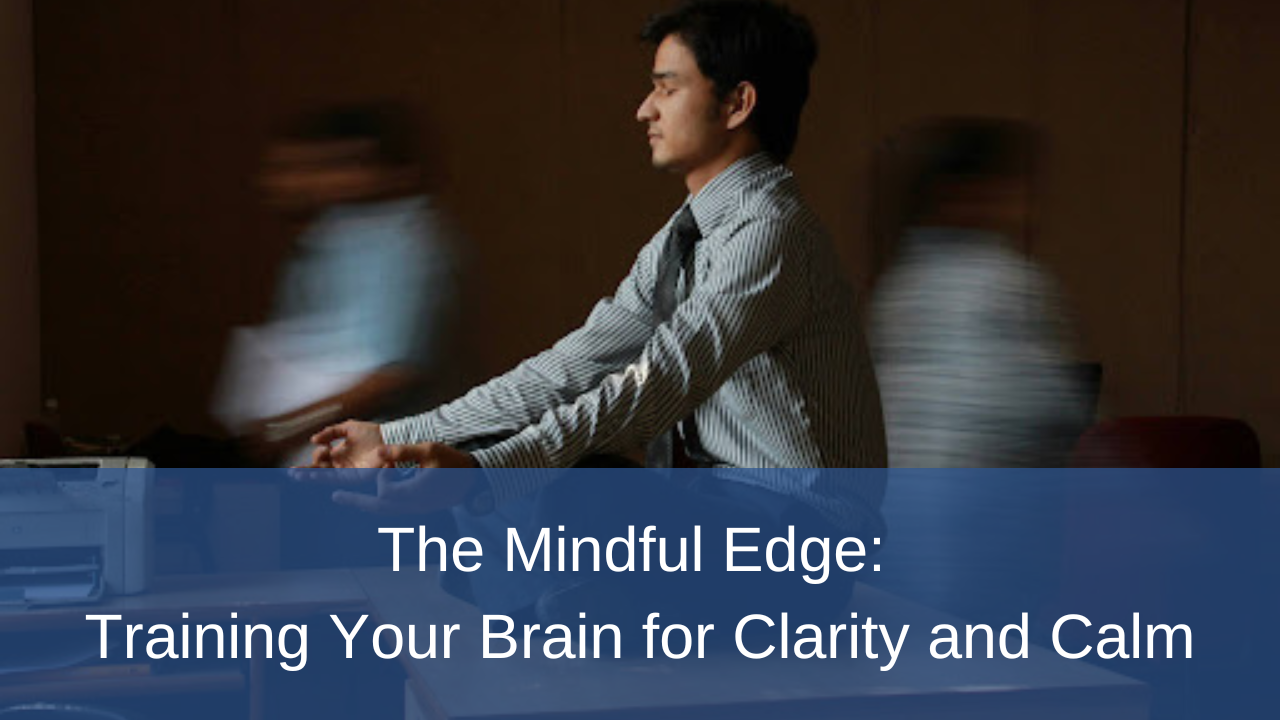
If a Mental Fitness Plan is your “workout routine,” then Mindfulness and Meditation are the heavy weights of the mental gym. While a “daily reset” helps you recover from stress, these practices actually rewire the brain’s response to stress before it even starts.
By moving beyond “fixing” and toward “training,” we can develop what athletes call “the quiet eye”—the ability to remain calm and focused while everything is moving fast around you.
1. Beyond the Myths: What is Mindfulness?
Mindfulness is often misunderstood as “emptying the brain.” In reality, it is the opposite: it is active awareness. * Meditation is the formal practice (the “gym session”) where you sit and train your focus.
- Mindfulness is the real-world application (the “functional strength”) where you stay present during a meeting, a meal, or a difficult conversation.
2. The Mental Gym: Three Techniques for Every Schedule
To complement your personalized fitness plan, try integrating these three core training styles. Each serves a different purpose for your mental energy.
A. The Focused Attention Training (The Anchor)
- The Practice: Choose one “anchor”—your breath, the feeling of your feet on the floor, or a single sound. When your mind wanders (and it will), gently bring it back.
- The Benefit: Like a bicep curl for your prefrontal cortex, this strengthens your “focus muscle” and reduces the “fog factor” mentioned in our Modern Blueprint for Resilience article.
B. The Open Awareness Scan (The Battery Check)
- The Practice: Instead of focusing on one thing, simply observe your thoughts and body sensations as if you were a neutral bystander. “I notice I am feeling rushed” or “I notice a tight shoulder.”
- The Benefit: This builds metacognition—the ability to see your “low battery” signs before they turn into reactive emotions or snapping at colleagues.
C. Micro-Meditation: The “One-Breath” Gap
- The Practice: Before clicking “Join” on a video call or opening an inbox, take exactly one conscious, slow breath. Notice the transition.
- The Benefit: This prevents “stress stacking,” where the tension from one task bleeds into the next, keeping your emotional energy stable throughout the day.
3. Mindfulness in Motion: Integrating Your Routine
You don’t need a mountain retreat to be mindful. You can integrate “Mindful Sprints” into the work you are already doing:
- Mindful Listening: In your next 1:1, try to listen without planning your response while the other person is still talking.
- The Sensory Walk: During your “Kinesthetic Break,” notice the temperature of the air on your skin or the rhythm of your footsteps instead of checking your phone.
4. The Long-Term Gains
Consistency beats intensity. Training your mind for five minutes a day is more effective for building resilience than meditating for two hours once a month. Over time, this practice changes the physical structure of the brain—shrinking the amygdala (the “alarm” center) and thickening the prefrontal cortex (the “logic” center).
By treating mindfulness as a core pillar of your mental fitness, you aren’t just managing stress—you’re upgrading your operating system.
***************************
Caroline Collins
Manager of People & Programs, Personal Trainer, Group Fitness and Yoga Instructor
Curtis Health
This article was written with the assistance of AI and verified for accuracy.
Sources
- The Greater Good Science Center (UC Berkeley): Research on how mindfulness meditation increases gray matter density in the brain.
- JAMA Internal Medicine: Meta-analysis on the efficacy of mindfulness-based programs in reducing anxiety and psychological distress.
- Mindful.org: Clinical perspectives on the difference between formal meditation and informal mindfulness.
- Dr. Jon Kabat-Zinn (Full Catastrophe Living): Scientific foundations of Mindfulness-Based Stress Reduction (MBSR).